
At first glance it might seem that the elaborate mechanism that dandelions Taraxacum officinale use for presenting pollen to visiting insects is a masterpiece of functional design. Look across the top of a dandelion flower with a magnifying glass and you can see a forest of stigmas, divided and curled back at the top of a long style covered in pollen. This is the last stage in a developmental process that begins in the flower bud ....

.... where at this stage the individual florets that make up the flower head (capitulum) are just on the point of flowering. From the bottom upwards in the photo above, first you can see the ovaries that contain the egg cells that will become the embryo in the seeds, then above them are the stamens, joined in a long yellow cylinder.....

... seen here in a single floret. Notice how at this stage the ring of feathery hairs (the pappus), that will carry the mature seed aloft on the breeze, is already well developed. This floret is one from the centre of the flower and has no petal, unlike those around the edge that have ray petals for advertisement ....

... like this one, where you can see the single petal attached. At this later stage of development the style has now elongated inside that cylinder of stamens, forcing its way upwards like a piston and sweeping out the pollen as it goes, then splitting at the tip to reveal the receptive stigma where pollen delivered by a visiting insect will germinate.
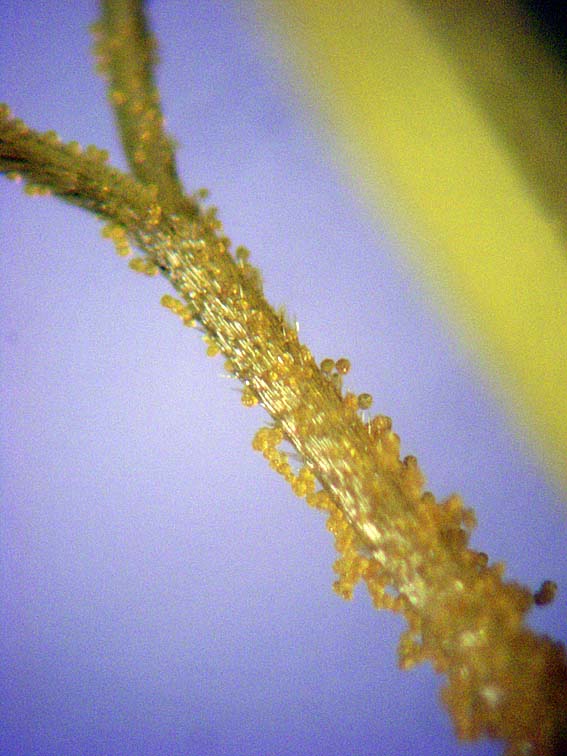
The outer surface of the style is covered in a forest of short hairs that help to sweep the pollen out of that cylinder of stamens. Pollen adheres to the outseide of the style until an insect arrives and collects it, at the same time cross-pollinating the stigma with the pollen from another that it arrived with.

But to the dandelions, all of this elaborate floral choreography is redundant - a waste of energy. At some point in their evolution they acquired a mutation that allows their ovules (above) to develop into seeds without any need for pollination, producing clonal, identical copies of the parent plant. It's a process called apomixis, that's also found in some other plants, including some bramble species. So in dandelions all that complex and energetically expensive floral development and the provision of pollen and nectar to attract pollinating insects, now serves no purpose - it's a legacy of an earlier stage in evolution, when dandelions did need to be cross pollinated. In some species of dandelion the pollination mechanism is still functional, but not in the apomitic common dandelion. Perhaps, at some point in the future, mutations will disable the pollen- and nectar-producing mechanisms in apomictic dandelions and they'll be able to shed the cost of producing these expensive resources for no purpose. For the moment, though, all that redundant pollen and nectar is a wonderful resource for bees in spring ....


