Friday, August 13, 2010

Defensive Weapons

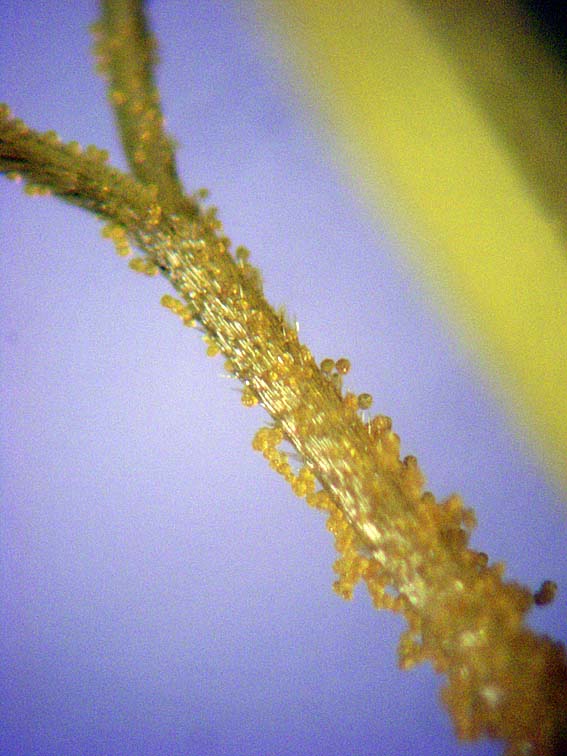
The outer layer of cells on a plant's surface - the epidermis - is the first line of defence against herbivores, pests and diseases so it's not surprising that many plants are covered with an array of defensive weapons. Sometimes these are cells that secrete repellent biochemicals, which give many plants a characteristic aroma when you brush their leaves. Other species have mechanical barriers, in the form of dense coverings of hairs (trichomes) to deter small insects like aphids. Stinging nettles are covered in a forest of complex stinging hair cells, each mounted on a pediment of cells. You can see some further, more detailed images of the structure of the stinging hairs here, but the image above is an aphid's-eye view of a nettle leaf underside - although they wouldn't see it in these lurid colours, which I generated using polarised light.

Wednesday, August 4, 2010

Gastrotrich

I've been struggling to capture a decent image of a gastrotrich for quite a while, but this afternoon this obliging example (Chaetonotus sp., I think) paused just long enough in my field of view for me to record it. Gastrotrichs are miniature aquatic equivalents of the roadrunner, always on the move - although in this case propelled by a layer of beating cilia on their underside (gastrotrich means 'hairy stomach') rather than legs. This one seemed to be feeding. That circular mouth, surrounded by a ring of tiny teeth, and the muscular pharynx that it leads to ingest just about anything that the animal collides with and that's small enough to enter the gap. The outer covering of cuticular spines give this gastrotrich a fearsome appearence and if you are smaller that it is (i.e. less than about a quarter of a millimetre) the sight of one of these high-speed hunters hurtling towards you must be a nightmare - not that pond life suffers from nightmares; sorry, lapsed into anthropomorphism there. Been watching too many horror movies.  


This specimen came from the edge of a Phragmites reed swarm, amongst the rotting debris in shallow water - a favourite habitat for gastrotrichs. You can see here how agile they are, capable of turning in their own length through 180 degrees. Those two appendages on the tail are adhesive organs. Gastrotrichs do sometimes rest and when they do they glue themselves to something convenient with adhesive secreted from the tips of those appendages. When they are ready to go again they secrete a releasing agent - that, and the glue, which both work under water, must be very interesting substances.

Monday, July 12, 2010

Pond scum


Three weeks of warm weather had left my pond covered with large slimy masses of 'blanket weed' or 'pond scum', the filamentous green algae that tend to plague ponds that have too much nitrogen in the water. When I'd fished most of it out I took a look at a few filaments under the microscope and - like so many living organisms - it revealed structures of great beauty when it was magnified a few hundred times. Inside each cell in the filament the chloroplasts were arranged like strings of green pearls. Various filamentous algae have chloroplasts in different conformations and the most familiar is the spiral chloroplast in Spirogyra..... but this is a different genus.....


The series of fine rings that you can see around the bottom of the upper cell on the left here, just above its junction with the cell below it, identify this alga as a species of Oedogonium. A ring forms each time a cell of this genus divides, so this cell appears to have divided three times.


In amongst the algal filaments there were also desmids - this crescent moon-shaped example is Closterium. The clear areas at the tips of the 'moon' are vacuoles, that contain insoluble crystals of calcium sulphate - a diagnostic feature of this genus.


The most interesting alga in my pond, however, was this one - Coleochaete. It may look like just a pad of simple cells (with some of them apparently dead) but this is an organism of great evolutionary significance. Modern molecular biological studies, and comparative investigations into the ways in which cells divide in this species and in land plants, indicate that Coleochaete shares a common ancestor with present day land plants - mosses, liverworts, ferns, conifers and flowering plants. At some point - maybe half a billion years ago - algae like this, perhaps living in a warm pool of nutrient-rich water like my garden pond, started to colonise the mud and begin the long series of evolutionary changes that led to the development of today's terrestrial vegetation.

A discovery like this makes the chore of cleaning out the garden pond a whole lot more interesting.......... 

Thursday, June 24, 2010

Rolling and Tumbling


This colony of organisms is Synura, a member of the Golden or Chrysophyte algae, that I found in a water sample in the shallows of a reed swamp. Each member of the colony has a pair of unequal length flagellae (to fine to see at this magnification), whose constant beating sends the colony rolling and tumbling through the water. It's about a fifth of a millimetre in diameter. When high concentrations of Synura build up in water bodies they impart a fishy taste, posing a problem for the water industry.

A static image doesn't do justice to it, but the short video clip below gives a better impression of its constant movement. 

Tuesday, June 15, 2010

Another Rotifer....

I've posted pictures of rotifers before (here) but they are such amazing animals that there's always room for another - especially this one, which looks like a monster from a sci-fi horror movie. I found it at the edge of a pond today and it is - I think - a species of Euchlanis, which belongs to a group called loricate rotifers. A lorica is a hard outer shell (the word lorica is Latin for 'body armour') that provides protection and maybe has hydrodynamic properties that aid swimming. The protective function is evident in this photograph (above), where the animal's head is withdrawn into its shield-shaped lorica, which has claw-like points guarding either side of the opening. The animal is about a fifth of a millimetre long.


It may be that the shield-shaped lorica also functions like a wing, generating lift as the animal swims through the water, powered by a tuft of fast-beating cilia at the head end-  which you can see beating in the short video below. When at rest the animal can anchor itself with its tail spines, which open and close like a pair of scissors.

These images were taken with differential interference contrast optics, which generate an apparent three-dimensional image of microscopic objects.

You can find out more about rotifers here.

Monday, May 31, 2010

Ahhhh-tishooooo!


For hay fever sufferers, this can be one of the most miserable times of the year, thanks to grasses and trees that produce vast quantities of wind-borne pollen. Nevertheless, pollen grains are beautiful natural objects. The pollen grains above belong to a tropical plant called cup-and-saucer vine Cobaea scandens, which is pollinated by bats rather than by wind (do bats suffer from hay fever? Probably not...).

I stained the pollen with a fluorescent dye called acridine orange, which binds to the surface of the pollen grain and fluoresces yellow when you shine blue light on it - revealing this exquisite pattern of hexagons and pores (showing green here). Each pollen grain is about one fifth of a millimetre in diameter. Plant genera can often be identified by the distinctive pattern on their surface.

The outer surface of pollen is full of minute pits and chambers that contain proteins that allow a plant to recognise pollen of its own species when it lands on its stigma, and reject foreign pollen. It's these proteins that quite literally get up your nose, trigger an allergenic reaction and set you off sniffing and sneezing.

The outer casing (known as the exine) is made up of a polymer called sporopollenin, which is incredibly resistant to biodegradation - which is why palaeobotanists can recover ancient pollen samples from deep in peat bogs and lake beds and extract and identify pollen samples from plants that grew there tens of thousands of years ago. It's a branch of botany that has given some very useful insights into how plant species distributions have changed during periods of rapid climate change, like the one we are experiencing now: studying the past in this way gives an insight in what is likely to happen to plant species in the future.


Since the exine of pollen is so resilient, it passes through the gut of insects unharmed, although the pollen contents are digested. Yes, that little white speck on this bumblebee's tail is bee-poo, made up of empty exines of pollen that it has eaten. Many hoverflies feed almost exclusive on pollen, leaving little piles of hoverfly poo on leaves, and I know of at least one enterprising entomologist who has collected and analysed this, in order to study hoverfly's pollen diet.

During the Vietnam war Yellow Rain - yellow specks coating plants in the jungle - was believed to be the result of Communist chemical warfare. Subsequent anaysis showed that it was bee faeces, produced by vast swarms of bees that sometimes rose into the air and defecated in unison.

Monday, May 24, 2010

Orange-tip Butterflies - More Than Just a Colourful Set of Wings?


This tiny orange rugby ball is the egg of an orange-tip butterfly  Anthocharis cardamines, attached to the flower stalk (pedicel) of a hedge garlic Alliaria petiolata plant in my garden. The caterpillar that hatches will feed on the host plant's developing seed pod, so the caterpillar must hatch soon after the flower is pollinated.


At higher magnification it's possible to see the beautifully patterned egg case, which will be the first thing that the caterpillar will eat when it hatches, before moving on to consumer tender young seed pods.


Female orange-tip butterflies (male seen above with wings open and shut) only lay a single egg per infloresecence, typically on lady's smock Cardamine pratensis but also on hedge garlic A. petiolata or on sweet rocket Hesperis matrionalis, although egg laying has been recorded on 35 members of the cabbage family (Cruciferae). You can see a fine photo of an orange-tip egg on lady's smock over at Stuart Dunlop's Donegal Wildlife blog. If more that one egg is laid per inflorescence the caterpillars resort to cannibalism, but the female butterfly can detect a pheromone signal left by another that has already laid an egg and will avoid that plant, minimising the risk of this gruesome outcome - unless it rains, when the pheromone is washed off. 

Back in 1997 research at Monk’s Wood National Nature Reserve established that the female butterflies that use lady’s smock as a larval food plant are extremely selective in their egg laying habits. They choose large flower heads in open, sunny locations. Choosing a flower head with a large number of buds ensures that there will be enough food (seed pods) for the hungry caterpillar.

Research in Durham University back in 1983 suggested that they also have quite a narrow window of opportunity for egg laying – if the eggs are laid when the inflorescence is too old the developing pods will be too tough for the larvae to eat by the time that they hatch. This can sometimes happen if bad weather delays egg laying, as the butterflies are only active in sunshine.

In my garden this delightful butterfly breeds on all three of the larval food plants - lady's smock, hedge garlic and sweet rocket - which have overlapping flowering periods that collectively span a period of about six weeks. Each plant has different pod development characteristics - hedge garlic, for example, has much larger, tougher, faster developing pods than lady's smock - so I wonder whether any member of the orange-tip population in my local colony can breed on all three - in which case they might need to adjust their egg laying habits to suit the individual host's pod development rates - or whether there are sub-populations that specialise on breeding on each of the different possible hosts. If the latter is the case, that would respresent the first step in subdivision of the population and of one species splitting into three .............. evolution in action...... or maybe they're not that discriminating. Something worth closer study though, I think. With that in mind, I'm planning to breed the butterflies on lady's smock and on sweet rocket, which represent the extremes of the range of flower timing, then see if the resulting butterflies exhibit a preference for laying eggs on either host plant when they hatch.

Sources:
S.P.Courtney and A.E.Duggan (1983) The population biology of the orange tip butterfly Anthocharis cardamines in Britain. Ecological Entomology 8, 271-281.

Dempster, J.P. (1997) The role of larval food resources and adult movement in the population dynamics of the orange-tip butterfly (Anthocharis cardamines). Oecologia 111 (4), 549-556.

Tuesday, May 18, 2010

So Much for Intelligent Design ....


At first glance it might seem that the elaborate mechanism that dandelions Taraxacum officinale use for presenting pollen to visiting insects is a masterpiece of functional design. Look across the top of a dandelion flower with a magnifying glass and you can see a forest of stigmas, divided and curled back at the top of a long style covered in pollen. This is the last stage in a developmental process that begins in the flower bud ....


.... where at this stage the individual florets that make up the flower head (capitulum) are just on the point of flowering. From the bottom upwards in the photo above, first you can see the ovaries that contain the egg cells that will become the embryo in the seeds, then above them are the stamens, joined in a long yellow cylinder.....


... seen here in a single floret. Notice how at this stage the ring of feathery hairs (the pappus), that will carry the mature seed aloft on the breeze, is already well developed. This floret is one from the centre of the flower and has no petal, unlike those around the edge that have ray petals for advertisement ....


... like this one, where you can see the single petal attached. At this later stage of development the style has now elongated inside that cylinder of stamens, forcing its way upwards like a piston and sweeping out the pollen as it goes, then splitting at the tip to reveal the receptive stigma where pollen delivered by a visiting insect will germinate.

The outer surface of the style is covered in a forest of short hairs that help to sweep the pollen out of that cylinder of stamens. Pollen adheres to the outseide of the style until an insect arrives and collects it, at the same time cross-pollinating the stigma with the pollen from another that it arrived with.


But to the dandelions, all of this elaborate floral choreography is redundant - a waste of energy. At some point in their evolution they acquired a mutation that allows their ovules (above) to develop into seeds without any need for pollination, producing clonal, identical copies of the parent plant. It's a process called apomixis, that's also found in some other plants, including some bramble species. So in dandelions all that complex and energetically expensive floral development and the provision of pollen and nectar to attract pollinating insects, now serves no purpose - it's a legacy of an earlier stage in evolution, when dandelions did need to be cross pollinated. In some species of dandelion the pollination mechanism is still functional, but not in the apomitic common dandelion. Perhaps, at some point in the future, mutations will disable the pollen- and nectar-producing mechanisms in apomictic dandelions and they'll be able to shed the cost of producing these expensive resources for no purpose. For the moment, though, all that redundant pollen and nectar is a wonderful resource for bees in spring ....

Monday, May 10, 2010

Four-eyed Fly


These remarkable eyes belong to a male St. Mark's fly Bibio marci - which has not one pair of compound eyes, but two. This is the black fly that dances just above the grass on spring days, dangling its long hind legs. You can find a picture of this behaviour on Nyctalus's Stand and Stare blog. These dancing males are on the lookout for females, which they approach from below, and the conjecture is that those long, fine hairs in between each individual compound eye lens (ommatidium) somehow help in the fly's detection of movement above and precise positioning when he grabs a female.

Remarkably, male and female St.Mark's flies have quite different eyes and are also distinctive in other respects. In this mating pair the larger female is above, with the more slender head, heavier body and smokey-coloured wings.

Both sexes have one pair of exceptionally long legs, that dangle below in flight, although the extent of the difference in leg length is over-emphasised in this picture of a male because the front two pairs of legs have curled up in death.


This head-on view of the male reveals a distinctive horizontal groove across each eye, just below the mid-point. In fact upper and lower eyes are quite separate on each side and have separate connections to the brain, where the images they produce are processed separately - the upper eye on the look out for females, the lower monitoring ground position. This fly has four eyes (as do whirligig beetles which swim on the surface of ponds and simultaneous look towards the sky and down into the water).


The female's heavier body, smokey wings and narrow head are evident in this side view, while ....

... a close-up view of the female's head reveals that her eyes are smaller and hairless - but then she doesn't have to worry about finding males; they find her with their strange two-tier visual system.

Thursday, May 6, 2010

Orchid Roots: Botanical Sponges

You can crudely divide orchids into two groups: ground orchids, rooted in the soil - like Pleione species, for example - and epiphytic orchids like the one below, that often grow on the branches of trees in tropical forests. The dangling roots of the epiphytic types have a dual role, sometimes anchoring the plant and always acting as storage vessels for water that they absorb from mist and sudden tropical downpours. If you cut a section through one of these roots (above) you can see their unique structure, that allows them to absorb and store water. The bright yellow ring of thick-walled cells at the bottom of the image above is the plant's internal plumbing - the pipes (xylem vessels) that conduct water from the roots to the leaves and flowers. Beyond that the thin-walled blue cells are the packing cells that are alive and contain some chloroplasts, like the leaves. Beyond that, sheathing the root and separated by a distinct layer of mostly hexagonal cells is an outer sheath of dead cells called the velamen layer, and their role is to soak up water as the roots dangle in the air, high above the forest floor. They are, in effect, a sponge.

The recommended way to water tropical orchids, like Vanda species for example, is simply to stand them in water for a few minutes each day, so their root velamen layer fills up with water, then simply hang the plants up with their roots dangling in space.

You can see here what happens when you water an orchid root here. When it's dry (above) the dead velamen layer cells reflect light and the whole root looks silvery-white. Make them wet for just a few seconds (below) and those dead cells fill up with water, become translucent and reveal the green photosynthetic tissue within.